

Portrait of a Moving Target 1 (A Concrete Casting Tube)
Portrait of a Moving Target 1 (A Concrete Casting Tube) consists of two 7' x 7' drawings mounted back to back on a freestanding support wall. Drawn using rust and dirt harvested from the depicted area, the drawings portray one empty concrete casting tube lying horizontally on the ground of a construction site. The life-sized drawings depict two views, seeing through both sides of the same tube. Anderson called it "A see-through drawing of nothing."
The work imagines the present as a concrete casting tube. Like the present, Anderson believes a casting tube has the unique ability to hold change, "it is the intermediary between before and after, past and future." The drawings depict an ongoing construction project in Honolulu, O‘ahu, Hawai‘i. The pictured tube is one of many used in the construction of an elevated urban rail transit system, otherwise known as the Honolulu Rail project. In his paper, Anderson cites Hawaiian poet Wayne Kaumaulii Westlake's poem "Construction," as another example of construction being related to time, the endless or infinite, and the absurd.
The documentation functions as a limited survey of the rail, the largest public works project in Hawai'i to date. The survey reflects an image of present-day O‘ahu and its place within trends of 21st-century urban sprawl. The drawings continue a lineage of historical survey drawings completed to document and assess a land’s topographical features, existing civilization, and future economic potential. Artists like John Webber accompanied British explorers in Hawai‘i in 1785, and Edward Kern the U.S. Army Corp of Topographical Engineers during Pacific railroad surveys in the newly American West in 1853.
Works in the exhibition [edit]
Background [edit]
Anderson references Mos Def (Yasiin Bey) in his thesis paper, as an artist who illustrated the contemporary world and present moment simultaneously in his 2000 song "Life In Marvelous
Times." Using a physical, anecdotal example or model to discuss an abstract concept was influenced by the short stories of Argentine author Jorge Luis Borges, “The Book of Sand,” and “On Exactitude in Science.”
The classical tale of the Myth of Sisyphus serves as one overarching theme for the project. The myth has been linked to absurdist philosophy and author’s such as Albert Camus, who parallel Sisyphus' task to man’s search for the meaning of life. It is unclear how directly the exhibition deals with such existential questions; Anderson equated the work to many tasks we can complete but never really finish, “Like the work of a library, or mapping the stars, doing the dishes, or keeping the bugs out of the house.”
"And we are alive in amazing times
Delicate hearts, diabolical minds
Revelations, hatred, love and war
And more and more and more and more
And more of less than ever before
It's just too much more for your mind to absorb
It's scary like hell, but there's no doubt
We can't be alive in no time but NOW!"
- From Life In Marvelous Times,
Mos Def, 2009
In 2019/20, as an MFA student at the University of Hawaii at Mānoa, Cody Anderson (b. Gillette, Wyoming, United States) used the idiom to categorize his thesis project; a series of artworks attempting to represent the present. The works were created using a wide range of materials but connected most through drawing. The exhibition “sets out to locate the present not just as a liminal moment, but also our historical, geographic, and cultural time today.” Each work is constructed as a model that imagines, or conceptualizes the present. The models reflect the paradoxical, or contradictory nature of the present, which Anderson sees as “constantly changing, two words which mean the opposite of each other.”
The work pulls from historical examples of documentary art to create "a series of open-ended documents - not a record, but a recording...They portray an image of the world in the process of being observed.” Anderson's open-ended documenting is both complete and incomplete, fact and fiction, and static and in-motion. Ironically poking fun at itself, the attempt to record an ever-changing subject points to documents and archives as being "distasteful, cumbersome, and likely to change tomorrow." Together, the various works operate like a concocted positioning system, “pinpointing the here and now with a dull carpenter’s pencil.”
Thesis exhibition [edit]

Installation view of Portrait of a Moving Target in The Art Gallery at the University of Hawai‘i at Mānoa
Contents [hide]
3.1 Portrait of a Moving Target 1
3.2 Portrait of a Moving Target 2
3.3 Portrait of a Moving Target 3
3.4 Portrait of a Moving Target 4
3.5 Portrait of a Moving Target 5
4 See Also
Article. Talk
Search Wikipedia
Read Edit View History


Not logged in Talk Contributions Create Account Log in
Further Reading [edit]
Selected Bibliography
-
Origin, from Love and Peace, Elvin Jones McCoy Tyner Quintet
-
Particle Theory, Marchel Deschamps and Judith Mohns ISBN 9780932526359
-
Six Drawings Lessons, William Kentrdige ISBN 9780674365803
-
Present Shock: When Everything Happens Now, Douglas Rushkoff ISBN 9781617230103
-
My People the Sioux, Luther Standing Bear ISBN 978-0803293328
-
Blank Spots on the Map, Trevor Paglen ISBN 9781101011492
-
Ē Luku Wale Ē, Piliāmo‘o, Mark Hamasaki and Kapulani Landgraf ISBN 9781883528423
-
Édouard Glissant: One World In Relation, Film by Manthia Diawara
-
From Beneath Mt. Ka‘ala, Punahele
-
Mind Sights: Original visual illusions, ambiguities, and other anomalies, with a commentary on the play of mind in perception and art, Roger Shepard ISBN 9780716721345
-
The Ecstatic, Mos Def
Articles and reports
-
Idioms, similes, metaphor, and hyperbole | Learner's Dictionary
-
Lili Rethi, organismic topographer (1894 -1971) | Milton Prior Institute
-
Bill Allows Construction Without Completed Archaelogical Survey | Hawainewsnow
-
Study to Identify the Presence of Previously Unidentified Traditional Cultural Properties in Section 4 for the Honolulu Rail Transit Project | SRI Foundation/Kumu Pono Associates
-
When it comes to Historical Markers, Every word matters | Smithsonianmag
-
like drawing a line in the sand at the ocean's edge | Drew Kahu‘āina Broderick
-
Arithmetic, Population, and Energy | Al Bartlett
-
Carbon County | Wyohistory
-
Industry, Politics and Power: the Union Pacific in Wyoming I Wyohistory
Portrait of a Moving Target (MFA thesis exhibition)
From Wikipedia, the free encyclopedia
“Portrait of a Moving Target” is an idiom used to describe one’s attempt to represent a constantly changing subject. Drawing on the traditional assumption that a portrait refers to painting, and paint is a static material; the results of a portrait of a moving target will inevitably be flawed or limited in some way.


Interaction
Tools
What links here
Related changes
Upload file
Special pages
Permanent Link
Page information
Wikidata item
Cite this page
In other projects
Print/export
Download as pdf
Printable version
Languages
Deutsch
Français
한국어
Italiano
Русский
Tagalog
Tiếng Việt
中文
Notes and references [edit]

-
^ "Exhibition Description". 2020 Master of Fine Arts Exhibitions. University of Hawai‘i at Mānoa Dept. of Art and Art History webpage. Retrieved Mar 16, 2020
-
^ Anderson, Cody. "Skype Interview with himself". Retrieved Mar 2, 2020.
-
^ Anderson, Cody. "Portrait of a Moving Target Artist Statement". The Art Gallery. University of Hawaii at Mānoa. Accessed Mar. 8, 2020.
-
^ Madbury Club. “Archive”. Accessed December 4, 2019.
-
Anderson, "Artist Statement"
-
^ Anderson, Cody. "Portrait of Moving Target". Thesis paper. University of Hawai‘i at Mānoa. 2020.
-
^Anderson, Cody. "Just be thinking to yourself sometimes, you know?" Sometime, 2019/20
-
^ Ibid
-
^ Anderson, Cody. "In conversation with Charles Berkley, his cat." Honolulu:HI. USAIN Mango Press. 2019. pg. 10.
-
^ Westlake, Wayne, Mei-Li M. Siy, and Richard Hamasaki. 2009. "Construction" from Westlake: poems by Wayne Kaumualii Westlake (1947-1984). Honolulu: University of Hawaii Press.
-
f
-
f
-
f
-
f
-
f
-
f
-
f
-
f
-
f
-
-
^ "Office of the State Auditor of Hawai‘i. Audit of the Honolulu Authority for Rapid Transportation: Report 1. By Leslie H. Kondo. Report No. 19-03. Honolulu, HI: State of Hawai‘i, 2019." Retrieved June 6, 2019.
-
^ "HART Audit Report 2. By Leslie H. Kondo. Report No. 19-04. 2019". Retrieved June 6, 2019.
-
^ David W. Forbes. "Encounters with Paradise: Views of Hawai'i and its people, 1778-1941". (Honolulu, HI: Honolulu Academy of Arts, 1992). 16.
-
^ Patricia Trenton and Peter H. Hassrick. "The Rocky Mountains: A Vision for Artists in the Nineteenth Century". (Norman, OK: U of Oklahoma Press, 1983). 73.
-
^ Kentridge, William. "Felix in Exile". Film. 1994. Retrieved April 5, 2019.
-
^ Anderson, Cody. "Memory bank". Retrieved Mar 16, 2020.
-
^ Anderson, "In conversation with Charles Berkley"
-
^ "Elk Mountain Web Camera". Wyoming Department of Transportation. Accessed daily.
-
^ "Taran Brown Highlight 2011". Proof of Cody's existence in Wyoming in 2011 (Look for #34). Retrieved Mar 16, 2020.
-
^ "Elk Mountain on internet map". Courtesy of Google Maps. Retrieved Mar 16, 2020.
-
f
-
f
-
f
-
f
-
f
-
f
-
f
-
f
-
f
-
f
-
f
-
f
-
f
-
f
-
f
-
f
-
f
-
f
-
f
-
f
-
^ Shadwell, Shelby. LOW PRESSURE. website page. Retrieved Mar 12, 2020.
-
^ Pfeiffer, Paul. “Field Notes: Paul Pfeiffer”. Interview by Nathan Lee. Film Comment, March-April, 2005. Retrieved Nov. 9, 2019.
-
^ "Empire". Andy Warhol. 1964. Film. Retrieved Feb. 29, 2020
-
^ "Empire: Paul Pfeiffer." Salt Online. Salt Beyoğlu. Turkey. Retrieved April 20, 2020

This article may require cleanup to meet Wikipedia's quality standards. The specific problem is: Needs to use citation templates consistently, may need to drop low quality books due to length. Please help improve this article if you can. (March, 2020) (Learn how and when to remove this template)
This page was last edited today and tomorrow at approximately lunchtime (HST)
Text is unavailable under the Creative Commons ShareAlike 3.0 because it got lost in the mail and I am out of stamps. To suggest an edit, please click here. By using this site, you agree to the Terms of Use and Privacy policy. Wikipedia is a registered trademark of the Wikimedia Foundation, Inc., a non profit organization.
Back to Cody's Projects Contact Cody Thesis Exhibitions of my cohort
Portrait of a Moving Target 2 (A Dog Chasing its own Tail)
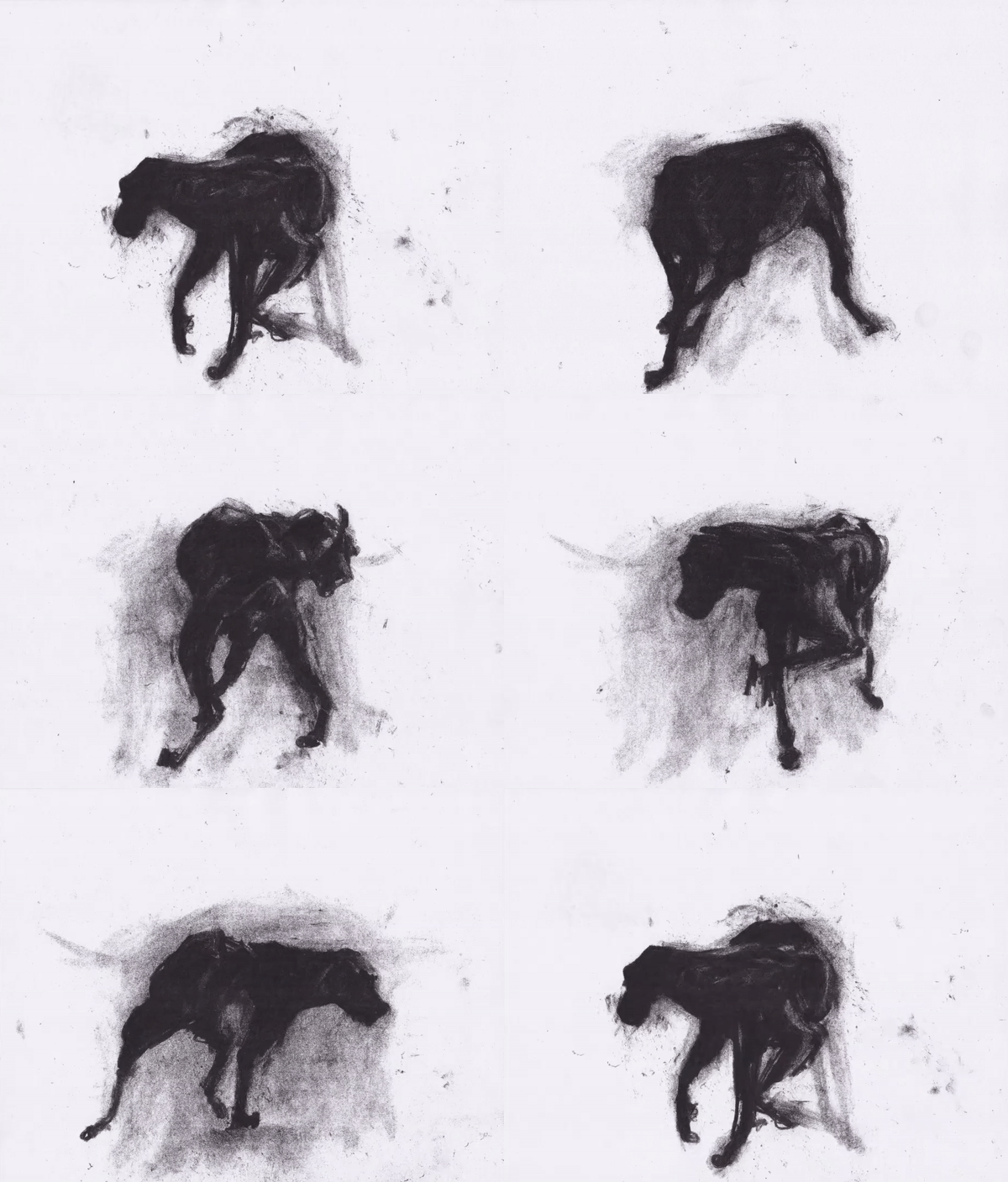
Portrait of a Moving Target 2 (A Dog Chasing its Own Tail) is a video projected low on the wall from inside a cardboard box. The video is a drawn animation, showing an excited black dog running in
circles attempting to catch its own tail. The dog appears at roughly life-size, its feet circling just above the ground. Each frame was made by repeatedly altering one charcoal drawing with small changes to the dog's position, a technique popularized and perfected by South African Artist William Kentridge. The drawing was photocopied after each alteration, and the 24 copies were then scanned and animated.
The model imagines the present as a dog chasing its own tail. The dog's infinite looping is always the same, but different. If (A Concrete Casting Tube) locates the present locally, (A Dog Chasing its own Tail) seems to locate more of a non-physical element of the present. Having a well-known relationship to working hard and accomplishing nothing, the dog’s curious action reads open-endedly, it can be applied to Anderson, the viewer, or society in general.
Animated GIF of (A Dog Chasing its own Tail)
Portrait of a Moving Target 3 (Books from the Future)
Portrait of a Moving Target 3 (Books from the Future) consists of a drawn historical marker sign for a series of events in the future; a cinder block viewing point; and a curving, downward sloping bookshelf appearing from a cut-out hole atop the gallery wall. The landmarker signs reads:
BOOKS FROM THE FUTURE - Visible from this lookout are assorted books descending onto earth from the future. The viewpoint seen today is not dependent on our unique geographic location or atmospheric conditions, but your own personal vision and perspective. While the books cannot be opened or read from the here and now, the provided binoculars can allow for a distant viewing of some of the titles.
After reading the prompt, a viewer can step on the marked cinder blocks and use the binoculars to look across the gallery and read the Books From the Future. The books covers/spines are hand-drawn with colored pencil and acrylic paint. The invented titles are open-ended, allowing you to fill in the blank: “The First…”; “Universal ___________”; "Re-defining…”. For this reason, it appears the sign and books do not so much predict the future, but create an exercise for imagining it.
Binocular view of (Books from the Future)

Pedestrian view approaching (Books from the Future). A "Shepard Elephant", or Legs'istential Quandary adorns the center of the historical sign.

Portrait of a Moving Target 4 (A Hole in the Earth)
Portrait of a Moving Target 4 (A Hole in the Earth) is a flat hole plummeting into the ground. The colored-pencil drawing is shown on the floor with dirt around its edges and a square plywood barrier. Assumingly, the barrier is meant to protect someone from falling into the hole. "A hole in the ground makes you extra aware of your current position, where your feet are standing, and what is underneath you." If (Books from the Future) looks upwards, toward the future; its possible the hole’s downward looking could represent the past. Looking into the ground references geology and archaeology as well-documented methods of historical analysis. Together, (Books from the Future) and (A Hole in the Earth) place a viewer in-between two unknown expanses.
Looking downward into (A Hole in the Earth)

Portrait of a Moving Target 5 (Photographs of Elk Mountain)
Portrait of a Moving Target 5 (Photographs of Elk Mountain) is an internet webpage displayed on an LCD screen hung on the wall like a painting. Shown in its original format, the webpage is a version of a traffic camera; a web-camera stream operated by the Wyoming Department of Transportation, Anderson’s home state. While most of the cameras focus on the interstate and highways to report weather conditions; the chosen camera focuses on Elk Mountain located south of I-80 on the route between Laramie and Rawlins in south-central Wyoming. The state has not disclosed its justifications for spying on the mountain.


A series of screenshots taken from the Elk Mountain web camera show a rainstorm advancing on to the mountain.
The work locates the present globally. Imagining the present as a radio broadcast, (Photographs of Elk Mountain) connects the present moment in the gallery, in Hawai’i, to that of another geographic location. Like the present, there is no replay, fast-forward, or rewind in a radio broadcast; each moment only exists when it exists. Refreshing in real-time, the webpage updates every six minutes with a new photograph of Elk Mountain, replacing its former image with a more current version. The web page's formatting includes a time/date stamp, location name, mile marker number, and state copyright information. Directly resulting from their position in the gallery, at that time, every viewer sees a unique image of the mountain.
The work comes after another durational video work of Anderson's, bonsailivestream.com, which started in 2019. Anderson's former professor at the University of Wyoming, Shelby Shadwell, also used the state road cameras as source material in his drawing series, LOW PRESSURE (2010-11). Inside a context of art history, (Photographs of Elk Mountain) continues a lineage of video works connecting reel time to real-time, works whose subject is not so much what the camera frames, but the apparatus itself. Anderson cites Andy Warhol's 8-hour plus film of the Empire State Building, Empire (1964), and Paul Pfeiffer’s 3-month long study of a wasp building her nest, also Empire (2004), as good examples. Both films utilize a singular, continuous, stationary shot for their entire duration. The deadpan, unedited presentations end up documenting the devices necessary to create them. In Anderson’s case, (Photographs of Elk Mountain) details contemporary uses of the camera, internet, and state surveillance.
Installation view of (Photographs of Elk Mountain)
